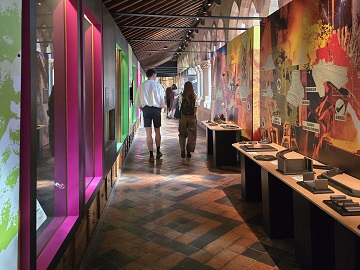
Our entire way of life rests on the supply of 34 critical minerals, defined by the British government as vital for our society to function. From aluminium to zinc, all of these essential substances are extracted from the Earth’s crust – but cannot be sourced in the UK.
A timely exhibition at the Oxford University Museum of Natural History explores the names and natures of these superstar minerals, and how scientists are trying to solve the gritty problem of sourcing, using and recycling them ethically.

I worked with Kelly Richards during the exhibition’s development to help refine the interpretation plan, messages and text direction. As with all its contemporary science exhibitions, the Museum drew creatively on its collections in the storytelling – in this case, extensive geological and mineral specimens – as well as interviewing key scientists, loaning in contemporary objects, and creating interactives and audio-visual materials to create the exhibition.
The aim was to produce a newsy and hard-hitting show. The UK’s critical list (each nation defines their own vital requirements) includes a spectrum of minerals required in our homes, hospitals, vehicles, aircraft and power stations. As demand grows, and the transition to net zero continues in response to climate change, the urgency to secure these minerals increases.
The exhibition reveals our reliance on helium in hospital equipment, cobalt in our mobile phones, lithium in EV batteries and neodymium for wind turbines – all on the critical list of 34. But the mining and extraction of minerals often involves opaque supply chains and exertion of unequal political power. Many of the minerals are finite, and some incur a huge environmental cost in their production.

So what are we doing about all this in the UK? Among many examples, the exhibition showcases scientists’ pursuit of ethical sourcing, noting that consumers don’t usually know the origins of the minerals in their products. And the exhibition highlights ways in which we could tackle our hunger for resources:
Reducing: cut the amount used per product.
Reusing: find ways to give products like batteries second lives.
Recycling: scale-up waste recycling .
Repairing: extend the life of each product.
Replacing: find alternative materials that are more easily available.
Improved processes for recycling and reuse can make a huge difference to the sums of each mineral required and the waste produced – notably with nickel, copper, cobalt, and lithium in energy production. High-tech materials are helping reduce impacts, for example in aviation, which is responsible for up to 3% of global carbon dioxide emissions. Nickel super-alloys grown into single aircraft fan blades allow engines to run hotter and more efficiently.

But as we transition from fossil fuels to cleaner, more sophisticated energy technologies, even-increasing quantities of neodymium for wind turbines, and indium and tellurium for solar panels are required.
The global cost of sourcing the 34 critical materials comes into focus in the exhibition’s design, and exhibits like the steel object table below. I found the whole show gave me a taste of reality and a thirst to pursue ways in which we can realistically move forward. Although no answers are straightforward, the exhibition’s infographic approach clarified the challenge, and the hopeful options available to us.

34: The Critical Raw Materials Shaping Our Future is at the Oxford University Museum of Natural History until 13 April 2027.